Join
AES
Join
AES
Contact
Us
Contact
Us
There is no shortage of governance reviews, member surveys, or financial dashboards in the association sector. What there isn't — anywhere else — is a single instrument that measures every system required to run a high-performing association.
That's what the AES Best Practice Self-Assessment tool does. Ten core areas of association management. A four-point scoring system. A common benchmark that compares associations on a like-for-like basis.
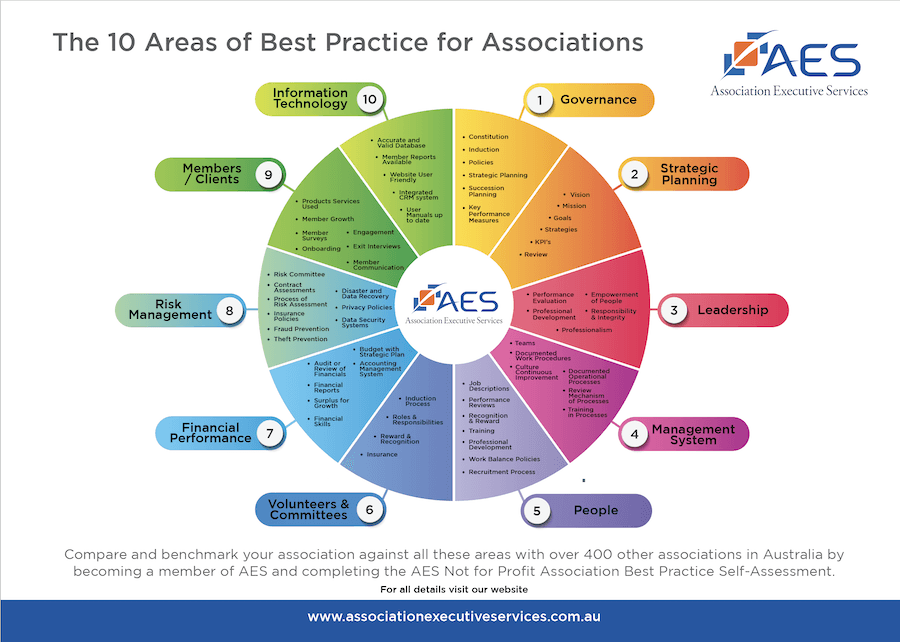
The team at Association Executive Services developed it more than 10 years ago, drawing on the Baldrige Award framework and refining it through decades of practical experience working alongside Boards and CEOs across Australia and New Zealand. We built it because the sector needed a tool that could identify what high performance looks like — and give Boards a credible way to celebrate managing a high-performing association.
And we have never stopped refining it. We continually update the self-assessment to reflect emerging governance standards, regulatory shifts, and the changing demands on association leaders. What was true about high performance in 2014 is no longer true in 2026. The AES self-assessment moves with the sector — because we do.
It is now used by leaders from over 800 associations in Australia.
This is the work AES exists to do. Helping association leaders make a difference — not with generic management theory, but with sector-specific tools, frameworks, and thinking developed from the inside out. The AES Self-Assessment is one expression of that commitment. It is the only one of its kind in our sector. And it works because we built it for the work we do every day.
Here's what it looks like in practice.
The Australian & New Zealand Society of Occupational Medicine is the peak professional society for those who practise occupational medicine, occupational nursing, and workplace health. In 2014, the ANZSOM Council was one of the first associations to undertake the AES Self-Assessment. Rather than treating the survey as a one-off, the Council used the results to identify gaps in its management systems and to develop strategies for continuous improvement.
They then repeated the survey in 2015, 2017, and 2019 — building a longitudinal record of improvement that few associations of its size can match.
Here's what the discipline produced.
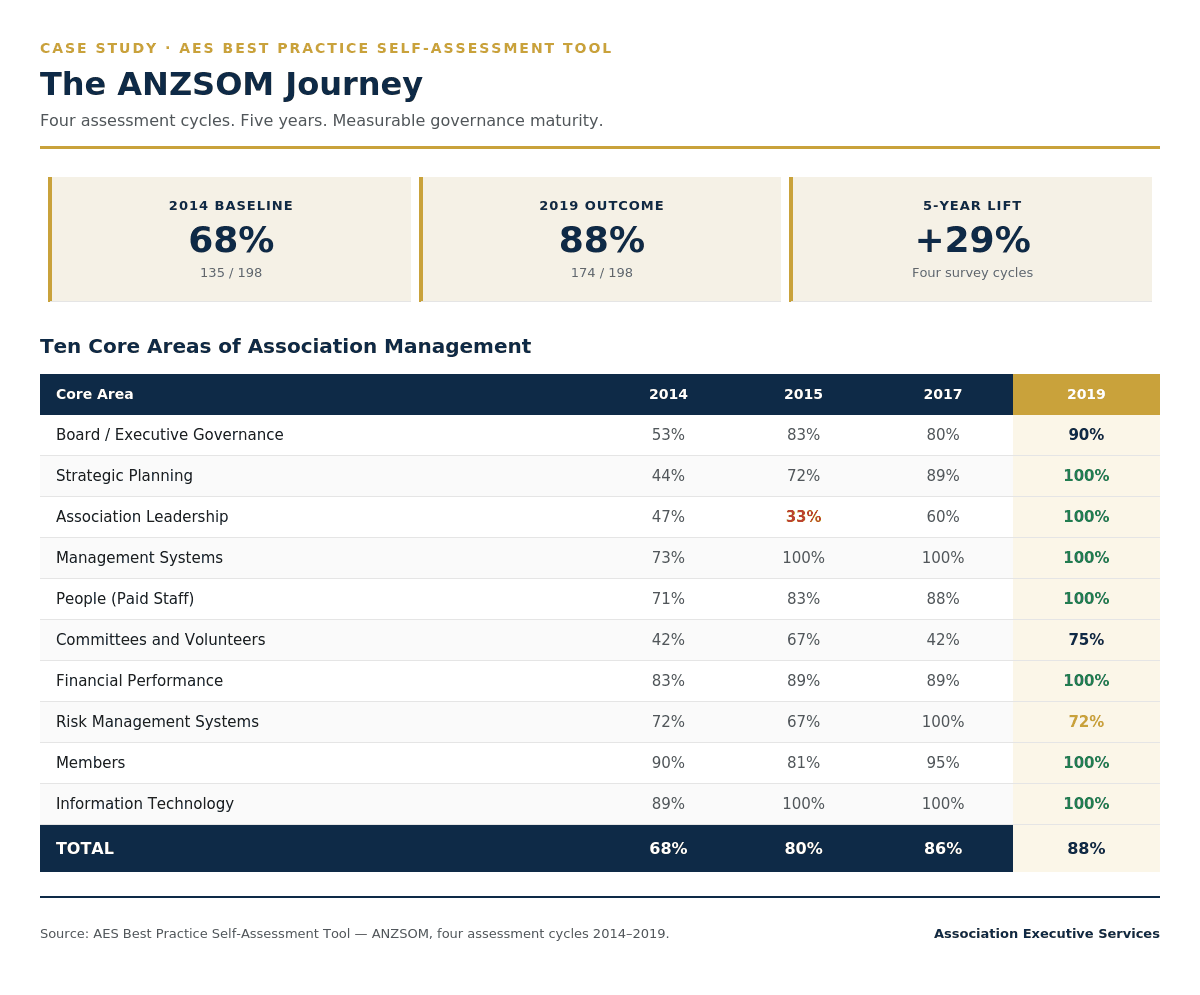
ANZSOM's total performance moved from 68 per cent in 2014 to 88 per cent in 2019 — a 29 per cent lift, firmly into the upper reaches of the Elements of Best Practice band. By 2019, ANZSOM was achieving 100 per cent of the best-practice target across eight of the ten core areas of association management.
But the headline isn't the most interesting part. The texture of the journey is.
Strategic Planning rose from 44 per cent to 100 per cent — ANZSOM had embedded strategic planning as a documented, evidence-based practice rather than an episodic activity.
Association Leadership saw the most dramatic shift, moving from 47 per cent in 2014, through a dip to 33 per cent in 2015, and on to 100 per cent by 2019. The 2015 result is the most useful number in the entire study. It proves the Tool is sensitive enough to catch a short-term setback before it becomes entrenched — and that the Council was honest enough to record it rather than spin it.
Risk Management Systems tells the opposite story. ANZSOM hit 100 per cent in 2017, then fell back to 72 per cent in 2019 — most likely reflecting staff turnover or changes to evidence documentation. Without re-measurement, this would not have been visible. The drift would have continued.
And ANZSOM hasn't stopped. The Council is still using the Tool today to refine their processes, test new ways of working, and lock in ongoing success. Twelve years on from their first assessment, the discipline of measuring, acting, and measuring again is now part of how the Society runs. That's what sustained governance maturity looks like.
That's the point most Boards miss — and the point a comprehensive tool, used repeatedly, makes impossible to ignore.
Used once, the AES Self-Assessment tool is a snapshot. Used repeatedly across years, it becomes a tool for organisational discipline—a recurring conversation that keeps the Board, the management team, and the staff aligned on shared standards of practice.
There is another payoff that doesn't always show up in the numbers. Associations that measure themselves against a comprehensive, sector-recognised standard gain something most Boards quietly wish they had — confidence.
Confidence to tell their members, their funders, and their stakeholders that the organisation is performing at a high level, and that the claim is evidenced. The AES Self-Assessment Tool is proven to deliver exactly that. It turns Board assurance into demonstrable assurance.
And the AES self-assessment reach now extends beyond the associations that use it on themselves. A growing number of associations have adopted the AES framework as the benchmark for best practices among their members — using it as the basis for industry awards, recognition programs, and prizes presented at their annual award nights.
What started as a self-assessment tool for association management has become the recognised standard of excellence against which members are measured. That is the strongest possible endorsement of a framework's credibility — when the sector you serve adopts it as its own.
ANZSOM didn't improve because they had a better Board. They improved because they were willing to be measured — and then willing to be measured again. Against the only Tool in the sector that measures everything that matters.
If your Board has never benchmarked its own performance against a comprehensive standard, or hasn't done so in years, the question isn't whether you'd score well. The question is what you'd learn.
If your organisation is a Enterprise or Premium Member you can access this self assessment complete the survey and it will produce a report which will be reviewed by our AES Consultants
.jpg)
Risk management is one of those areas that every association and not-for-profit Board knows is important - but it can sometimes become
little more than a risk register reviewed once or twice a year.
Insurance can be treated in much the same way.
The organisation receives its annual insurance renewal, the premium is approved, the policy is renewed and everyone assumes the organisation
is covered.

A practical look at volunteer governance, operational decision-making and what the events industry needs to understand about associations.

Nick Koerbin has spent many years working with professional and industry associations, and he has developed a simple habit: whenever he
meets a professional, he often asks whether they belong to their association — and whether they believe the membership is worth it.
A recent conversation with a young allied health professional raised some important questions about membership value, relevance and the
expectations of the next generation.
In this article, Nick shares that conversation and challenges association leaders to consider a simple but confronting question:
Would the next generation of professionals in your sector believe your association is worth joining?
How we help membership based, not-for-profit associations now and into the future.